History does do irony, sometimes
On this day in 1945...

There are bad lawyers. But there are also good lawyers. And sometimes the good guys win. Also, history can do irony.
On this day in 1945, a bomb dropped on the People’s Court in Berlin. Most people in the building had taken cover but the President of the Court, one Roland Freisler, had returned to pick up some files. When the building partially collapsed, Freisler was crushed under a masonry column that flattened him like roadkill.
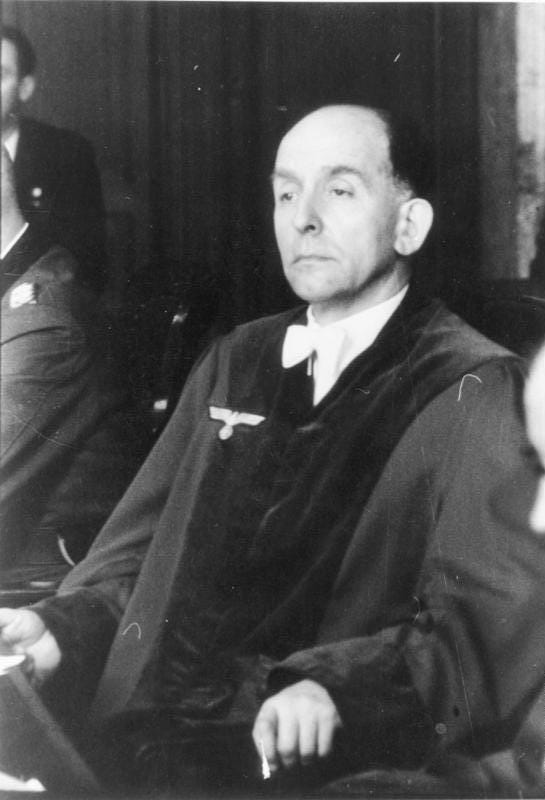
It couldn’t have happened to a nicer guy. Freisler, then 51, was so unpleasant that he made even other Nazis uncomfortable.
He had qualified as a lawyer just after World War One and practiced in Kassel. He also became an early Nazi, joining the party in 1925. The Nazis never quite trusted him. Still, after 1933 he was given a senior post in the Prussian Ministry of Justice, where he got rid of the Jewish members of staff. And he became one of the Party’s legal theorists, calling for instance for a legal prohibition of miscegenation (that is, sex between races); sex with a racial inferior, including a Jewish person, was, he argued, “race treason”. In 1942 he took part in the notorious Wannsee Conference, which decided on the “final solution to the Jewish question”.
Later that year was appointed to preside over the People’s Court, which had been established in 1934 to try political enemies. Under Freisler, any pretence at due process (there had been a little) went out of the window; in fact his vigour alarmed even Goebbels. He put people to death. Lots of people. They included Hans and Sophie Scholl and their friend Christoph Probst – the so-called White Rose – who he sent to the guillotine in 1943. His courtroom technique was to scream at defendants and humiliate them, famously depriving defendants of belts and braces so he had to hold up his trousers in court. From July 1944 he tried all those suspected of plotting to kill Hitler.
One of the files Freisler was clutching when he was flattened was that of an officer named Fabian von Schlabrendorff, who had been an active plotter for some time. What Freisler did not know was that von Schlabrendorff himself had come within inches of killing Hitler the previous year, when he smuggled a bomb described as a Cointreau bottle onto Hitler’s aircraft in Smolensk; he explained it as a gift for another officer back in Germany. The bomb had failed to go off, putting von Schlabrendorff in danger of detection. He had flown to Hitler’s HQ at Rastenburg, where he managed to retrieve it. This time, however, he seemed to face certain death. But Freisler’s death delayed his trial. He was sent to Dachau and then, with other high-profile prisoners, moved to South Tyrol, where he was liberated by American forces on May 4.
So to the irony. Von Schlabrendorff was himself a lawyer. After the war he assisted the American legal team at Nuremberg and eventually served as a judge on West Germany’s Federal Constitutional Court.
But there’s more. The American raid on Berlin that morning was led by a distinguished and highly decorated New Yorker, Lieutenant Colonel Robert Rosenthal. And there we have the final irony; he too was a lawyer, and he too later served on the US legal term at Nuremberg, interrogating both Göring and Keitel.
Also, he was Jewish.
History does do irony.